

Categories

Archives

The Latest Book from Bruce

The Secrets of Happy Families

Improve Your Mornings, Rethink Family Dinner, Fight Smarter, Go Out and Play, and Much More

The Secrets of Happy Families book coverBest-selling author and New York Times family columnist Bruce Feiler found himself squeezed between aging parents and rising children. He set out on a three-year journey to find the smartest ideas, cutting-edge research, and novel solutions to make his family happier. READ MORE


The Council of Dads

A Story of Family, Friendship & Learning How to Live

The Council of Dads book coverWhen bestselling author Bruce Feiler was diagnosed with a malignant tumor in his leg, he could only imagine all the walks he might not take with his daughters, the ballet recitals he would miss, the art projects left undone, and the aisles he might not walk down. READ MORE

Read Bruce’s cancer diary.

Bruce's latest news

The Secrets of Happy Families featured and tested on ABC’s Nightline. Watch the video here.

A great review of ‘The Secrets of Happy Families’ in the Washington Post!

How Happy is Your Family? Take the quiz in Parade Magazine and check out the feature on NPR and in USA Today.

Posts Tagged ‘sarcoma’

A Happy Milestone

Monday, December 10th, 2012

Four years to the month after the surgery that made this photo possible, I was touched to see this ad in the New York Times Magazine today.

Paging Dr. Gupta! See Sanjay’s Special on THE COUNCIL OF DADS

Monday, May 3rd, 2010

Here is Dr. Sanjay Gupta’s extraordinarily moving special about me, my cancer, and THE COUNCIL OF DADS. You’ll laugh. You’ll cry. You’ll not believe what was in my leg or that I’m riding a bike again.

CNN Presents: DADS FOR MY DAUGHTERS.

The special will air in its one-hour form on Father’s Day Weekend.

6 Good Men: The Council of Dads Adds a New Twist to Friendship

Sunday, April 25th, 2010

*Apr 08 - 00:05*
From the New York Daily News.

Bruce Feiler’s twin daughters, Eden and Tybee, were 3 when he was diagnosed with a rare form of bone cancer in 2008. Just days afterward, the best-selling Brooklyn author came up with the idea of asking six friends to look out for his daughters should he not survive. Feiler’s moving new book, “The Council of Dads,” tells their story.

How did the Council of Dads come about?

It was a reaction to a fear about what my daughters’ lives might be like without me. The first thing I imagined was all the things I would miss … all the questions they would have. “What would Daddy think about this?” “What would Daddy say about that?”

Where did the idea spring from?

I awoke from a half sleep, and there was … this letter forming in my head to my closest friends asking them to be there to answer my daughters’ questions. I said out loud, “I will call this group of men the Council of Dads.” As soon as I said those words, it seemed like they lived in the room.

How did you choose the members?

I was trying to fill the dad space. My wife, Linda, and I agreed that we should pick people who embodied all sides of me, each phase of my life. There is a travel dad. A make-your-dreams-happen dad. A values dad. A playful dad. A thinking dad. A nature dad. Now I kind of think of it as a team of godparents updated for a modern age.

How did it affect your friendships with the men?

The first time I read the letter to a friend I’d chosen, he’s crying. I’m crying. He said yes, and I was taken aback. I hadn’t realized this was a request you could turn down. In the end, they weren’t family, they weren’t just friends anymore. We − my wife and I and the girls − just had this whole new relationship in our lives.

It also changed your life?

The Council of Dads turns out to be less about parenting and more about friendship. We all think there’s a divide between family and friends. And when you have children, you can be so busy you think you don’t have time for friends. This built a bridge between our closest friends and our closest treasures, our children.

How did the Council work?

They never came together. They would come to see me in the hospital. But what started happening is that they would always build in time to visit with the girls. These aren’t just Daddy friends anymore. They are friends of theirs. The girls have nicknames for all of them.

You’re cancer-free. What is the status of the Council of Dads?

There is something incredibly powerful about telling your closest friends what they mean to you. It’s like we’re friend-married now. It’s like “till death do us part.”

The Council is an idea that is catching on.

The word has gotten around, and others are forming their own councils. I’m seeing divorced women do councils of dads because they want the male voice in their children’s lives. Women have councils of moms. I’m involved with a special program with the military to form councils of moms and councils of dads.

What do your daughters know about the Council?

They know they have a Council of Dads. They don’t know that the shadow of mortality hangs over the thing. I want to be honest with them, but not too honest.

Yay Daddy!!

Saturday, April 3rd, 2010

The ongoing miracles of a rebuilt leg. Today I completed my first HOPSCOTCH in two years! Here was my reward from my daughters.

yaydaddy1

Am I Really a Modern-Day “Danny Ocean?”

Thursday, April 1st, 2010

The first review of THE COUNCIL OF DADS thinks so. (And I think they mean it as a compliment.) From Hemispheres.

BRUCE FEILER—whose books have recounted his adventures teaching in Japan, joining the circus and, in the best-selling Walking the Bible, retracing the steps of Abraham, Moses and other figures from scripture—likes to call himself an “experientialist.” But the experience recounted in his slim but moving new book, The Council of Dads: My Daughters, My Illness, and the Men Who Could Be Me, is one you wouldn’t wish on your worst enemy.

In July 2008, Feiler, an inveterate walker and world traveler in his mid-40s (“I’ve sprained my ankle on six continents,” he says), was diagnosed with a rare form of cancer in his leg. Suddenly fearing he might not have long to live, the father of then-two-year-old twin daughters Tybee and Eden hit upon a unique plan: Like Danny Ocean assembling his perfect heist squad, Feiler would enlist six men, reflecting various aspects of his own personality, as his stand-ins. The hope, he writes, was that “together, collectively, they might help father my potentially fatherless daughters.”

The resulting book is a stirring hybrid: a memoir of Feiler’s cancer treatment coupled with a heartfelt meditation on parenthood, masculinity and living life to its fullest. Combining a chronicle of what he calls his “lost year” (including months of chemo and a 15-hour surgery) with portraits of Feiler’s own father figures and his Council of Dads, it’s honest, heartfelt and exceedingly raw. The book’s power comes in part from Feiler’s willingness to delve into emotions—including feelings of tenderness not only for our children and spouses but between male friends—that aren’t often spoken of with such candor. “There I am with no hair, a scar from here to here, talking to my friends,” the author explains, sitting with a cane in the Brooklyn, New York, apartment he shares with his wife, Linda Rottenberg, and the girls, surrounded by art collected during his years of globe-trotting. “The experience forced me to drop the normal trappings of contemporary life—vanity, pretense, ambition. It was very clarifying. I was still in the twilight of that feeling when I sat down to write the book. I just didn’t care. And it poured off my fingers.”

Interestingly, the result turns out to have less to do with disease than with life itself. While women will undoubtedly find the book fascinating for the light it casts on the vagaries of the male mind, men will almost certainly be moved to reexamine their own roles as fathers and as friends. “I didn’t set out to write a book about being male in America,” Feiler says, “but people keep telling me that’s what I did.”

When Daddy Is Gone

Friday, March 12th, 2010

I just read a beautiful essay by Kevin Helliker about the cost of losing a parent on young children. Interesting stat: Four percent of children lose a parent before age 15, usually a dad. I was surprised that figure was so low. Here’s an excerpt.

Having known my own father for 48 years, I’ve gained perspective from a wife who knew hers for only eight. When I call my 76-year-old dad tomorrow to wish him a happy Father’s Day, he will compliment me on this essay. He reads everything I write.

But without any hope of hearing her father say he is proud, my wife still strives to please him. In her mind, the sound of his voice still echoes, calling her smart, calling her pretty, laughing at her jokes. Twenty-five years after his praise fell silent, being worthy of it still means everything to her. Despite having thrived in the field of journalism — and having received loud hurrahs from her supportive mother — she felt called to follow the path of her father. Last year, she finished law school, passed the bar and entered the practice of law.

The first time I heard her speak about her father I understood that she was in love with him, and at that instant I started falling in love with her. As she gushed about how he had played baseball for a farm club of the Chicago White Sox, how his prosecutorial skills had won him a prestigious award from the U.S. attorney general, how he had posthumously been named one of the outstanding lawyers in Colorado history, what I heard was elation over how much he had loved her. It occurred to me his greatest achievement had been as a father.

Little science exists about the lasting influence of dead fathers, but outcome data suggest that it is powerful. Such data show that children who lose a father fare significantly better than those whose father is alive but not present, and nearly as well as those who never lose theirs. About 4% of American children will lose a parent before the age of 15, and nearly 75% of those losses will involve a father, reflecting the greater vulnerability of men to accident and illness, say bereavement experts. They stress that the loss of a mother can be similarly overcome, especially if the child received professional counseling and sensitive care from the surviving parent.

After years of studying the role of mothers in early life, psychoanalysts are turning with fervor to the influence of fathers. Just last year, an international consortium of Freudian analysts convened a seminar at Columbia University called “The Dead Father,” based in part on the premise that the role of the father in early childhood has been underappreciated. “The father has tended to get left out of the theorizing,” says Stuart Taylor, a Columbia University psychiatrist who helped organize the seminar.

Sarcomas at the Olympics!

Friday, February 12th, 2010

Mom of osteosarcoma survivor — and Canadian hero — Terry Fox carries Olympic flag in Opening Ceremony. Terry ran a marathon with a prosthetic leg! A great moment for all sarcoma survivors!!!

Read his amazing story here.
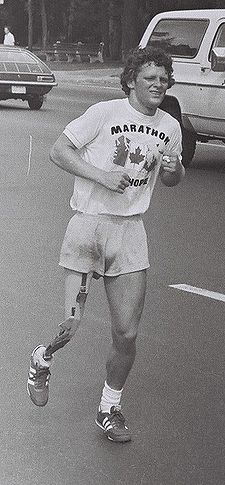
Terry Fox

Do you need a Council of Dads or Council of Moms?

Friday, February 12th, 2010

Roy Bahat wonders, then doubts, then seems to inch up to the line.

Michael Lazerow doesn’t exactly say yes, but he’s so enthusiastic maybe he’s persuadable.

Thank You For Survival

Sunday, January 31st, 2010

One-year ago today I was leaving the hospital after my 50th night in less than 150 days. Today, I sat on a stationary bike in a darkened room with over 100 other riders and pedaled for over half an hour. I spent the first half-hour today almost choking on my emotion, and by day’s end, as the inspirational founder of Cycle for Survival handed over a check to my doctors for $2.2 million dollars, I was completely overcome. Upstairs, Linda held Tybee and Eden in her arms and cried as she had not done in many, many months. The celebration was tinged with the news that a leading rider will begin chemo treatment on Tuesday for her fourth recurrence of a soft-tissue sarcoma in the last five years. We join the 2,000 other people who participated today in lending a shoulder of support for her coming days.

Thank you for participating in this deeply memorable day. Thank you to those who gave up their high-tech spinning gear for mere low-tech tennis shoes, to those who came in from New Jersey, to those who left their kids for the morning, to those who babysat, or sacrificed a more exciting day in New York City, or got cut off after just a few minutes on the bike.

And a deep thank you to those who donated to this extremely important cause – raising money to support sarcomas and other rare and orphan cancers. I met a men today who is already in a clinical trial that is being supported by money raised last year from this event. I am personally very grateful, as were the many children, family members, and others touched by the random horror of forgotten diseases.

We were not alone today. And we will not forget.

Love,

Bruce (and Linda)

To make a contribution or learn more about this amazing event, please click here.

The First Review: “The Single Most Inspiring Book I’ve Ever Read”

Tuesday, January 26th, 2010

Few things take my breath away completely, unexpectedly. This did.

A few weeks ago I participated in a ceremony to ring the opening bell at the NASDAQ. It seems that someone’s stock truly went up that day!

Today, one of the people I met that day posted this beautiful story — the first printed comments about THE COUNCIL OF DADS.

This morning on my flight to San Francisco I read “The Council of Dads: My Daughters, My Illness, and the Men Who Could Be Me,” the latest book by Bruce Feiler that comes out this April. This is the first time in my life I have read a book cover to cover in one sitting and I can unequivocally say that Bruce’s book is the single most important and heart-felt and inspiring book I have ever read.

[snip.]

While the descriptions of the Council members and what each wants to share with Bruce’s daughters are poignant, enlightening and thought-provoking, it’s Bruce’s own writing about what it was like to fight the cancer during his “Lost Year” while facing imminent death, all in front of two young daughters, that makes The Council of Dads such an astonishing read.

His treatment included an aggressive chemo regime and a 15-hour surgery right out of a sci fi movie in which doctors removed several bones from his leg and reconstructed it in a titanium-filled procedure only one person has ever survived.

Please be warned that this is not one man’s grasp for attention — “look at me, I survived cancer.” It’s a journey of the mind and body, family and friends, love and sadness, in which the author stays present with his emotions throughout and recounts them with vivid detail.

“As you can see,” Bruce writes, “cancer is not linear. Our lives rock unaccountably – and unpredictably – among moments of hardship, stress, joy, pride, laughter and exhaustion. There is profundity to explore, but also laundry to do.”

Bruce’s ability to mix the profound and awe-inspiring with the mundane makes his book accessible and universally actionable to help you live a more balanced and focused life.

Early in his war against cancer, Bruce writes that cancer “is a passport to intimacy. It’s an invitation – even a mandate – to enter the most vital, frightening, and sensitive human arenas.”

By chronicling in such depth and compassion and pain his own relationship with cancer, Bruce’s book serves a passport to understanding and an invitation for each of us to ask ourselves “Who is my Council of Dads?”

Thanks Bruce for a wonderful book that will help guide my life for many years to come.

To read the entire review by Michael Lazerow, click here.

Thank you, Michael. See you on the bikes!